
Agentic AI Systems Development
Riverborn designs and deploys enterprise agentic AI systems. Multi-agent orchestration architectures, Guardian Agent governance, and autonomous decision infrastructure built for production scale. Projects start at $10,000.
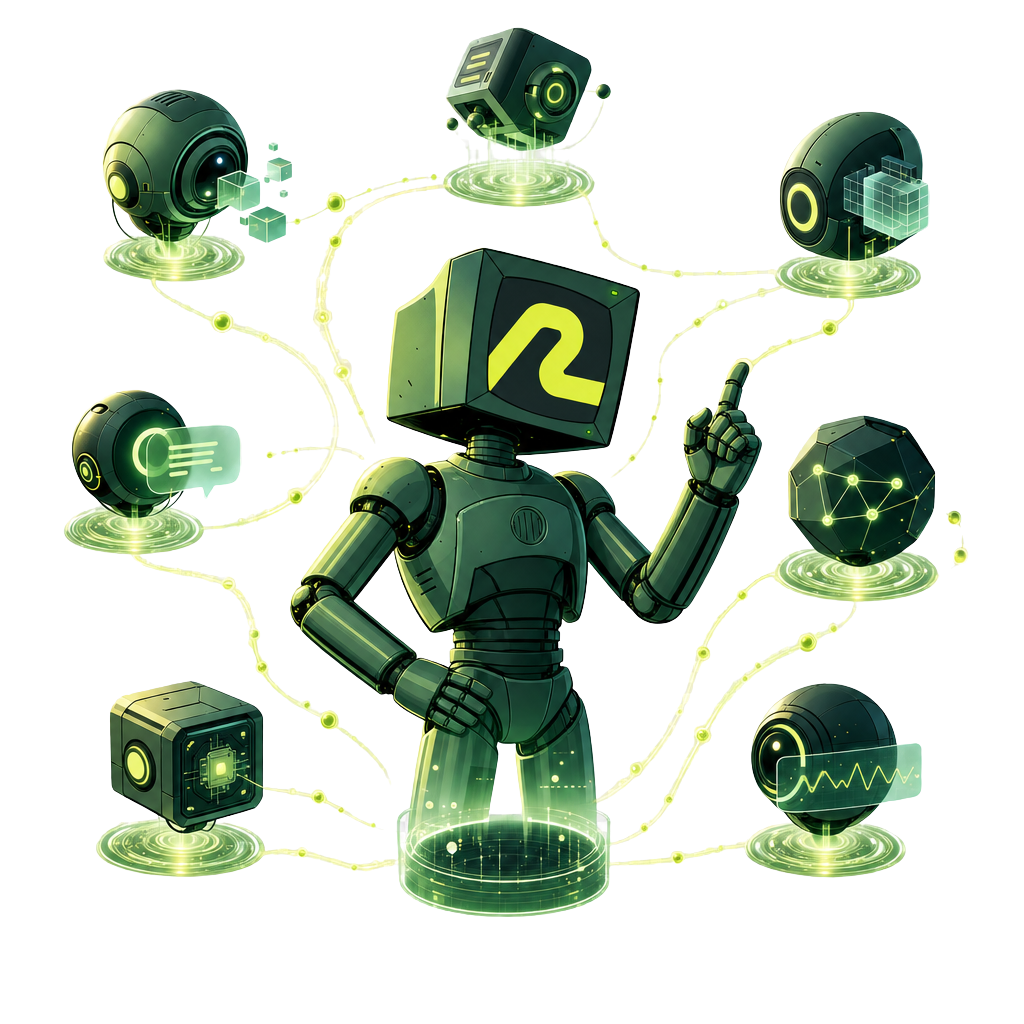
- GUARDIAN AGENT + POLICY-AS-CODE ON EVERY MAS DEPLOYMENT
- LANGGRAPH · CREWAI · AUTOGEN · GOOGLE ADK
An agentic AI system is an autonomous multi-model architecture that plans, executes, and self corrects complex multi-step tasks with minimal human intervention. For your team, that replaces fragmented automation tools and disconnected AI pilots with a coordinated agent network that handles entire business processes end to end. Riverborn is an agentic AI development company that designs and deploys these systems using Google ADK, LangGraph, CrewAI, and AutoGen. Every deployment includes Guardian Agent governance as a standard architecture component. Dhoni, Riverborn’s own production agentic system, processes 100K+ voice interactions using the same multi-agent architecture Riverborn builds for enterprise clients.
What Your Team Gets
using Google ADK, LangGraph, CrewAI, and AutoGen with supervisor worker critic hierarchy. So your enterprise deploys coordinated agent networks, not isolated single-agent tools.
a secondary oversight agent monitoring all primary agent decisions in real time, enforcing Policy as Code rules, triggering human in the loop review at configured boundaries, and generating compliance audit trails on every decision.
machine-readable compliance rules embedded directly in agent code and evaluated at each decision step. Your governance is enforced at runtime, not applied as post-hoc external filters.
(onboard, review, retrain, retire) for enterprise agent fleets. So your agents maintain performance against RoA metrics across their full operational lifespan.
cross functional governance body with named roles (Agentic Process Architect, MAS Engineer, Autonomy Auditor, Trust Lead) and defined review cycles.
Overlay, As a Service, or By-Design, calibrated against Deloitte's enterprise AI integration taxonomy. Projects start at $10,000.
What Is Agentic AI? Category Definition
Agentic AI systems development is a category within advanced artificial intelligence engineering. Agentic AI system types include multi-agent orchestration platforms, autonomous decision systems, self correcting agent meshes, and enterprise agentic workflow engines. An agentic AI system consists of a planning layer, a reasoning core, a tool calling interface, a memory system, and a Guardian Agent governance layer.
Agentic AI differs from single AI agents in scope, decision authority, and system complexity. A single agent executes a defined task within limited scope. An agentic AI system orchestrates a network of specialized agents with defined roles, a Guardian Agent oversight layer, A2A protocol communication, and RoA metric tracking.
Agentic AI systems operate across a three position autonomy spectrum:
Copilot
Copilot systems require human approval before each agent action.
Semi-Autonomous
Semi-autonomous systems route only exceptions to human review.
Fully Autonomous
Fully autonomous systems execute the entire goal independently, with the Guardian Agent enforcing Policy as Code boundaries throughout.
Enterprise deployments typically begin at semi-autonomous and progress to fully autonomous as RoA metrics validate performance.
According to Deloitte’s 2028 enterprise agentic AI forecast, North America will account for 42% of global enterprise agentic AI deployments. MIT Sloan and BCG research confirms that 79% of organizations deploying agentic AI augment human judgment rather than replace human roles. Agentic AI shifts human roles from Operators to Supervisors to Orchestrators, as people move from task execution to agent oversight and system governance.
What Riverborn Builds: Agentic AI System Types
Riverborn delivers five categories of agentic AI solutions as part of its autonomous AI systems development services. Each system type includes a named architecture pattern, governance layer, and integration scope.
Multi-Agent Orchestration Systems (MAS)
A supervisor agent receives the goal and decomposes it into a task dependency graph. Specialized worker agents execute assigned subtasks in parallel where the graph permits. A critic agent evaluates worker outputs against quality criteria using the RAGAS framework. The Guardian Agent monitors all agent decisions against Policy as Code rules before executing any external action. Google ADK, LangGraph, CrewAI, and AutoGen orchestrate the MAS, and A2A protocol governs all inter-agent communication.
Autonomous Decision Systems
Autonomous decision systems evaluate complex inputs, apply multi-step reasoning, and output structured decisions without per decision human review. Applications include compliance classification, risk assessment, resource allocation, and dynamic pricing. Governance requires a Guardian Agent with configurable confidence thresholds and human in the loop escalation paths for decisions exceeding defined boundary conditions.
Self Improving Agent Meshes
These agent networks monitor their own performance against RoA metrics, identify underperforming workflows, and propose prompt, memory, or routing updates. Self improving agent meshes represent the highest autonomy level on the autonomy spectrum. Deployment at this level requires full Guardian Agent governance and Agent Lifecycle Management infrastructure.
Agentic Orchestration Platforms
Agentic Orchestration Platforms provide platform level infrastructure for organizations deploying multiple agent systems across departments. The platform includes a central agent registry, unified Policy as Code rule management, and a cross-system A2A protocol layer. A consolidated RoA metrics dashboard and Agentic CoE governance integration complete the architecture.
Enterprise Agentic Workflow Systems
Enterprise Agentic Workflow Systems apply agentic AI to end to end enterprise processes at Autonomy Ladder L4 and L5. These processes include order to cash, compliance monitoring, supply chain coordination, and research synthesis. These systems integrate with existing ERP, CRM, and HRIS via MCP protocol and REST API. → See also: AI Workflow Automation Service for process-specific scope.
Our Technical Approach: System Architecture
Gartner’s 2025 AI predictions indicate that over 40% of agentic AI projects will be canceled before production due to inadequate governance frameworks. Guardian Agent governance and Policy as Code enforcement are the architectural components that address this failure mode. Riverborn’s agentic AI architecture contains four framework elements, each implemented as a distinct engineering component on every engagement.
Multi-Agent System (MAS) Architecture
The supervisor agent receives the goal input and decomposes it into a task graph with dependency edges. Worker agents execute assigned subtasks using LLM reasoning (GPT-5.6 or Claude Sonnet 5), tool-calling APIs, and memory retrieval from Qdrant, Pinecone, Weaviate, or pgvector. The critic agent evaluates outputs against quality criteria using the RAGAS framework (faithfulness, relevance, context precision). Outputs that fail evaluation re enter the reasoning loop before delivery. The A2A protocol structures all inter-agent communication: task assignment format, status update schema, result packaging, and escalation routing. The MCP protocol standardizes tool, context, and resource exposure across the agent network.
Guardian Agent Governance Layer
A secondary oversight agent runs in parallel to all primary agents throughout the system's operation. The Guardian Agent receives a real time copy of every agent decision before any external action executes. Policy as Code embeds machine readable governance rules directly in agent code: content filters, budget constraints, compliance boundary definitions, and decision confidence thresholds. Human in the loop review triggers when a decision exceeds a configured financial threshold, output confidence falls below a specified percentile, or the Guardian Agent detects a regulated action class. Every Guardian Agent evaluation generates a structured audit log covering decision input, Policy as Code rules evaluated, evaluation result, HITL trigger status, and resolution outcome.
Agent Lifecycle Management
Onboarding covers task definition, tool registry configuration, memory setup, API credential scoping, and RAGAS baseline testing before production deployment. Performance review evaluates agents quarterly against RoA metrics: Autonomy Rate, First-Pass Yield, and cost per decision reduction. Riverborn's production deployments benchmark Autonomy Rate at 74 to 92% and First-Pass Yield at 88 to 96% for RAG-augmented agent outputs. Underperforming agents receive prompt updates, memory index refreshes, or tool registry revisions. Retirement includes audit trail generation, permission revocation, API credential rotation, and knowledge transfer documentation.
Agentic CoE Design
The Agentic Center of Excellence is a cross-functional governance body defining agent deployment standards, review cycles, and escalation procedures. Four named roles compose the CoE: Agentic Process Architect (workflow design), MAS Engineer (infrastructure), Autonomy Auditor (RoA and compliance evaluation), and Trust Lead (Guardian Agent governance and HITL protocol).
Industries and Use Cases
Riverborn’s enterprise agentic AI deployments are scoped to RoA targets at architecture phase and measured at production deployment.
Financial Services: Compliance MAS
A global bank processing 50,000+ daily transactions required multi-regulation compliance evaluation across 12 jurisdictions. Riverborn deployed a 4-agent MAS: data extraction agent, regulation retrieval agent using RAG with Qdrant, or Pinecone, compliance evaluation agent using Claude Sonnet 5, and escalation routing agent. Guardian Agent policy enforcement governed all decisions.
Manufacturing: Supply Chain Autonomous Decision System
A manufacturer managing dynamic supplier allocation across 80+ suppliers with daily demand fluctuation deployed an autonomous decision system using LangGraph state machine orchestration. The system evaluates supplier capacity, delivery reliability scores from pgvector, contractual constraints, and current demand to allocate orders without per-decision human review. Guardian Agent enforces procurement policy rules.
Enterprise SaaS: R&D Intelligence MAS
A technology company required continuous monitoring of 200+ research publications weekly for competitive intelligence synthesis. Riverborn deployed a 5-agent MAS: ingestion agent, classification agent, relevance scoring agent, synthesis agent (GPT-5.6 structured output), and distribution agent. Guardian Agent enforced factual accuracy thresholds.
Technology Stack
Every agentic AI system ships on the production-validated stack below.
| Stack Layer | Technologies & Frameworks |
|---|---|
LLM Reasoning Core BASE REASONING | GPT-5.6Claude Sonnet 5Claude Fable 5Claude OpusLlama 4Mistral Large ↳ Note: Selected by decision complexity, compliance requirements, and cost per decision |
Orchestration Frameworks AGENTS + WORKFLOWS | LangGraph (state machine)CrewAI (role-based MAS)AutoGen (conversation MAS)LangChain (tool integration) |
Agent Communication INTER-AGENT PROTOCOLS | A2A Protocol (inter-agent)MCP servers (context exposure)gRPC (high-frequency)Kafka (event coordination) |
Memory & Knowledge VECTOR + CONTEXT | QdrantPinecone (managed)Weaviate (self-hosted)pgvector (PostgreSQL)Redis (short-term session buffer) |
Guardian Agent Layer PROPRIETARY GOVERNANCE | Custom Guardian Agent runtimePolicy-as-Code engineLangSmith (decision tracing)OpenTelemetryAudit log database ↳ Note: Proprietary Riverborn architecture |
Evaluation Framework QUALITY ASSURANCE | RAGAS (faithfulness, relevance, context precision)Custom RoA metric dashboardsAutomated regression testing |
Infrastructure DEPLOYMENT PROFILE | Docker + Kubernetes (containerized MAS)AWS ECS/EKSGCP Cloud RunGCP Compute EngineAzure AKS ↳ Note: Selected by enterprise cloud strategy |
Governance & Compliance POLICY ENFORCEMENT | Policy-as-Code rules engineHITL trigger configurationAudit trail databaseRBACCost budget enforcement |
LLM Reasoning Core
↳ Note: Selected by decision complexity, compliance requirements, and cost per decision
Orchestration Frameworks
Agent Communication
Memory & Knowledge
Guardian Agent Layer
↳ Note: Proprietary Riverborn architecture
Evaluation Framework
Infrastructure
↳ Note: Selected by enterprise cloud strategy
Governance & Compliance
Enterprise Integration Patterns
Deloitte’s enterprise AI integration taxonomy defines three patterns for deploying agentic AI into existing enterprise infrastructure. Riverborn’s integration pattern selection is calibrated against this taxonomy during the Agentic Scope and Goal Architecture phase.
Overlay
Agentic AI layer added above existing systems. No architectural disruption. Agents access existing data and systems via API. Fastest time to value.
Trigger Condition
Organizations with mature digital infrastructure seeking rapid agentic capability deployment.
Riverborn Delivery
API integration layer and MAS orchestration above existing ERP, CRM, and HRIS. Accelerated delivery: 6 to 8 weeks.
As-a-Service
Agentic capabilities consumed via API from Riverborn's hosted agent infrastructure. Organization defines goals. Riverborn manages agent architecture, hosting, and governance.
Trigger Condition
Organizations without internal AI engineering capacity requiring production-grade agentic capability.
Riverborn Delivery
Fully managed MAS platform with SLA-backed uptime, Guardian Agent governance, and monthly RoA performance reports.
By-Design
Agentic AI embedded into system architecture from inception. Agents are core components of new platform builds, not add on layers. Highest long-term capability ceiling.
Trigger Condition
Organizations undertaking platform rebuilds or launching AI native products.
Riverborn Delivery
Full stack agentic architecture design and build from specification through production deployment.
How It Works: Our Delivery Process
Riverborn delivers agentic AI development services through a five phase process. Full MAS deployment with Guardian Agent governance and Agentic CoE design completes in 12 to 14 weeks. Overlay integrations complete in 6 to 8 weeks. By-Design builds run 16 to 24 weeks.
Step 1: Agentic Scope and Goal Architecture
System goals, agent roles, decision authority boundaries, task dependency graph, and integration scope are defined before architecture design begins. Target Autonomy Rate and First-Pass Yield are locked as success metrics at this phase.
Deliverable
Step 2: MAS Architecture Design
Full agent hierarchy design (supervisor-worker-critic-Guardian), A2A protocol specification, and MCP server configuration are documented. Memory architecture, integration pattern selection, and Policy-as-Code rule set are finalized before any engineering begins.
Deliverable
Step 3: Agent Development and MAS Build
Each agent is built: reasoning loop, tool-calling interface, memory layer, and A2A communication protocol. The Guardian Agent runtime and Policy as Code enforcement engine are integrated. The full MAS is assembled and tested in the staging environment.
Deliverable
Step 4: Governance Configuration and Testing
Policy as Code rules are configured and validated. HITL trigger thresholds are calibrated and the audit trail database is verified. Adversarial testing, edge case simulation, and RAGAS quality evaluation establish RoA metric baselines before production.
Deliverable
Step 5: Production Deployment and CoE Design
The system deploys to containerized production infrastructure with LangSmith and OpenTelemetry observability dashboards configured. Agent Lifecycle Management procedures are established, and the Agentic CoE governance structure is designed: body composition, review cycles, and named role onboarding.
Deliverable
Why Riverborn
According to Gartner 2025, over 40% of agentic AI projects will be canceled before production due to inadequate governance. The governance architecture is the implementation decision that determines whether an agentic AI system reaches production or stalls at pilot.

GOVERNANCE METHODOLOGY
Named governance architecture on every deployment.
Guardian Agent, Policy as Code, Agent Lifecycle Management, and Agentic CoE design are Riverborn's delivery methodology for enterprise agentic AI. All four components ship as standard on every MAS engagement.
PRODUCTION PROOF
Production-validated agentic architecture.
Dhoni processes 100K+ voice interactions using the same multi-agent architecture Riverborn builds for enterprise clients. The same team that designed Dhoni's MAS, Guardian Agent governance, and Policy as Code rule set designs client systems.
CROSS-CAPABILITY DELIVERY
Convergence of every Riverborn engineering capability.
Agentic AI systems require simultaneous delivery across LLM application development, RAG pipelines, NLP, workflow automation, system integration, and production deployment. Riverborn's 10+ production AI products validate cross-capability delivery at each layer of the agentic AI engineering stack.
COST STRUCTURE
A cost structure that sustains the governance depth.
Riverborn's Bangladesh delivery model provides production-grade agentic AI solution quality at 40 to 60% of the cost of comparable US and EU enterprise AI firms. Engagements start at $10,000 for a focused single-system build.
4.8+ avg.client rating
Dhoni 100K+production interactions
10+ AI productsshipped globally
Guardian AgentPolicy-as-Code on every MAS
Lifecycle Mgmt.onboard, review, retrain, retire
40–60% cost edgevs US/EU enterprise AI firms
Related Services
AI Agent Development
Single AI agent development forms the building block of every agentic AI system. Riverborn's AI agent development service covers individual agent builds across conversational, task-execution, and retrieval-augmented types.
Learn moreAI Consulting and Strategy
For organizations evaluating whether their enterprise is ready for agentic AI deployment. The Maturity Audit determines integration pattern suitability (Overlay, As-a-Service, or By-Design) before architecture design begins.
Learn moreAI Workflow Automation
Agentic AI systems at Autonomy Ladder L4 and L5 overlap with enterprise workflow automation. For organizations targeting specific process automation rather than full MAS architecture, this service provides a scoped entry point.
Learn moreIndustries We Serve
Riverborn’s agentic AI deployments concentrate in financial services, SaaS and technology, and manufacturing. Each vertical is covered with RoA-scoped use case patterns in the Industries and Use Cases section above. Enterprise buyers across all verticals can access the full MAS deployment scope through AI for enterprise.
Frequently Asked Questions
An agentic AI system is an autonomous multi-model architecture that plans, executes, and self-corrects complex multi-step tasks with minimal human intervention. It differs from a single AI agent in scope, decision authority, and system complexity. Deloitte's 2028 forecast projects North America at 42% of global enterprise agentic AI deployments.
A single AI agent executes a defined task within limited scope. An agentic AI system orchestrates a network of specialized agents across a multi-step goal. A supervisor decomposes the goal, workers execute subtasks, a critic evaluates outputs, and a Guardian Agent enforces Policy-as-Code governance throughout. Scope, decision authority, and governance requirements differ fundamentally.
A multi-agent system is an architecture in which specialized AI agents collaborate to achieve a shared goal through defined role assignments and inter-agent communication protocols. The MAS hierarchy consists of a supervisor agent, worker agents, a critic agent, and a Guardian Agent oversight layer. Riverborn builds MAS deployments using Google ADK, LangGraph, CrewAI, and AutoGen with A2A protocol governing all inter-agent communication.
The Guardian Agent is a secondary oversight agent that runs in parallel to all primary agents. It receives a real-time copy of every agent decision and evaluates it against Policy-as-Code rules. It triggers human-in-the-loop review at configured boundaries and generates a structured audit log on every evaluation.
Policy-as-Code is the practice of embedding governance and compliance rules directly in agent code as machine-readable rule sets. These rules (content filters, budget constraints, compliance boundaries, decision confidence thresholds) are evaluated by the Guardian Agent at each decision step. Policy-as-Code governs agent behavior at runtime rather than through post-hoc external filters applied after decisions are made.
RPA executes structured rule scripts against defined inputs. Traditional automation requires predefined conditions for every branch. Agentic AI reasons over goals, handles exceptions through LLM inference, coordinates specialized agents in parallel, and self-corrects outputs against quality criteria. Agentic AI operates at Autonomy Ladder L3 through L5.
An Agentic CoE is a cross-functional governance body defining agent deployment standards, review cycles, and escalation procedures. It introduces four roles: Agentic Process Architect, MAS Engineer, Autonomy Auditor, and Trust Lead. MIT Sloan and BCG research confirms 79% of organizations deploying agentic AI augment human judgment through supervisory roles.
Full MAS deployment with Guardian Agent governance and Agentic CoE design completes in 12 to 14 weeks across five phases. Overlay pattern integrations complete in 6 to 8 weeks. By-Design platform builds run 16 to 24 weeks depending on architecture scope.